
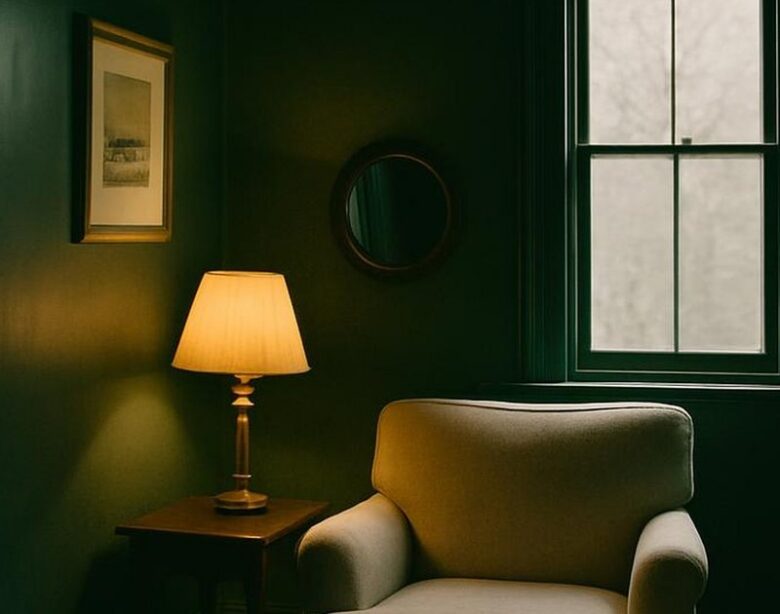
When it comes to decorating dark rooms, painting them white is rarely the answer. White needs daylight to look white; in a north-facing room it goes grey and flat. Going darker, and taking one colour over the walls, the woodwork and the ceiling, often makes the same room feel bigger, warmer and calmer. That approach is called colour drenching. Here’s where it works, where it doesn’t, and how to test a shade before you commit.
Why white fails in a north-facing room
A north-facing room in a British house gets cool, even light with no direct sun. Pale walls reflect that light back as a bluish grey, and every shadow shows. The room reads as dim rather than bright, and the contrast between white walls and a dark window or dark furniture makes the edges of the room obvious. You see exactly how small it is.
A deep colour does the opposite. It stops trying to be bright, so it stops looking as though it has failed. Shadows disappear into the wall colour, corners soften, and the eye stops measuring the room. Many of the cosiest rooms in Bath’s Georgian terraces are the north-facing ones painted a deep green or a warm brown, used in the evening with the lamps on.
What colour drenching is
Colour drenching means painting everything the same colour: walls, skirting, architrave, door, window frame, picture rail and ceiling. Sometimes the radiator too. The point is to remove the lines. A white ceiling on a dark room draws a hard edge at the top of the walls and makes the ceiling feel lower. A white skirting draws a line around the floor. Take those lines away and the room becomes one soft volume. Furniture and pictures stand out against it instead of competing with the woodwork.
You can vary the finish while keeping the colour: a flat matt on walls and ceiling, an eggshell or satin on the woodwork so it wipes clean and catches a little light. Same colour, two sheens, is the version we use most.
Where colour drenching works
- North-facing rooms, for the reasons above.
- Small rooms: a box room, a downstairs loo, a study. Removing the lines makes a small room feel like a jewel box rather than a cupboard.
- Rooms used mostly in the evening: a snug, a dining room, a television room. Lamplight on a deep colour is the whole point.
- Hallways and landings with lots of doors and awkward angles. Painting every door and frame the wall colour quietens the clutter.
- Rooms with ugly or mismatched woodwork. One colour over new and old joinery hides the join.
- Low ceilings, surprisingly. Without a white ceiling to mark where the walls stop, the ceiling height becomes hard to read.
Where it doesn’t
- Rooms where you need to see colour accurately: a home studio, a sewing room, anywhere you choose fabrics or paint for a living. Deep walls tint everything in the room.
- Kitchens with a lot of fitted cabinetry in a colour you’re keeping. A drenched kitchen works when the cabinets are in on it; otherwise you end up with a dark wall framing a pale run of units.
- Rooms you want to feel bright by day: a south-facing kitchen or a conservatory. Drenching isn’t wrong there, it’s just unnecessary.
- Rented homes, unless the landlord has agreed in writing. Painting the ceiling and woodwork is a lot to put back.
- When you can’t decide on the colour. A drenched room is committed. If you’re between two shades, test longer rather than guessing.
Choosing the colour for the light you’ve got
The same tin looks different in every room, so this is a starting point rather than a rule.
| Light in the room | Colour families that tend to work | Watch out for |
|---|---|---|
| North-facing, cool, flat | Deep greens, warm browns, aubergine, inky blue with a red base | Greys and cool blues go cold and dull |
| East-facing, bright mornings, dim afternoons | Warm terracotta, deep ochre, olive | Yellow-greens can look sickly in the afternoon |
| South-facing, warm all day | Almost anything; deep blues and charcoal stay lively | Very warm reds can feel hot in summer |
| West-facing, golden evenings | Plum, rust, deep teal | Pale colours bleach out at sunset |
How to test a shade before committing
Don’t paint patches straight on the wall. Small squares next to the old colour tell you nothing, and the old colour changes how you read the new one. Instead:
- Paint two coats on large pieces of lining paper or card, at least A2 size, one per shade you’re considering.
- Pin one up at a time and look at it morning, afternoon and evening with the lamps on. Move it to the darkest corner and the wall opposite the window.
- Paint a piece in the woodwork finish too, and hold it against the skirting.
- Put the furniture you’re keeping next to it: the sofa fabric, the rug, the curtains. A colour that fights the sofa is the wrong colour, however nice it is on its own.
- Live with the favourite for a week. If you still like it on a grey Tuesday, buy it.
Lamp bulbs matter as much as the paint. A deep colour under a cool-white bulb looks muddy; under a warm bulb it glows. Decide the lighting at the same time as the colour, not afterwards.
Furniture and pictures in a drenched room
Once the walls are one colour, everything in front of them reads more clearly. Light wood, brass, cream linen and glass all stand out. Dark furniture sinks in, which can be exactly what you want for a big wardrobe you’d rather not notice. Pictures need a frame that contrasts a little with the wall, or a mount, or they vanish. Mirrors earn their place in a dark room more than anywhere else: one opposite the window doubles the light you do have.
FAQ
Does colour drenching make a room look smaller?
Usually the opposite. Removing the lines between wall, ceiling and skirting makes the room harder to measure by eye, and the corners recede into the colour. It’s bright white with dark woodwork that shows you exactly where the room ends.
Should the ceiling really be the same colour as the walls?
For a true drench, yes. If that feels like too much, use the wall colour on the woodwork and a tint of it (the same colour mixed with white) on the ceiling. That keeps the softness without the full commitment.
What finish should I use on the woodwork?
Eggshell or satin in the same colour as the walls. It wipes clean and catches a little light, which gives the room some quiet variation without introducing a second colour.
Can I colour drench a room with a very low ceiling?
Yes. A white ceiling marks a hard line at the top of the wall and tells the eye how low it is. One colour over both takes the line away. Keep the woodwork finish a touch glossier than the walls so the room has some life.
Next step
Decorating dark rooms is partly about the paint and partly about the lamps, the fabrics and where the furniture sits, and those decisions are easier made together. We can help with a colour and lighting plan, a mood board that puts the paint next to the fabric and the floor, and samples you can move around the room at different times of day. Our services are described here, and a first conversation is free and without obligation; get in touch and tell us which way the room faces.